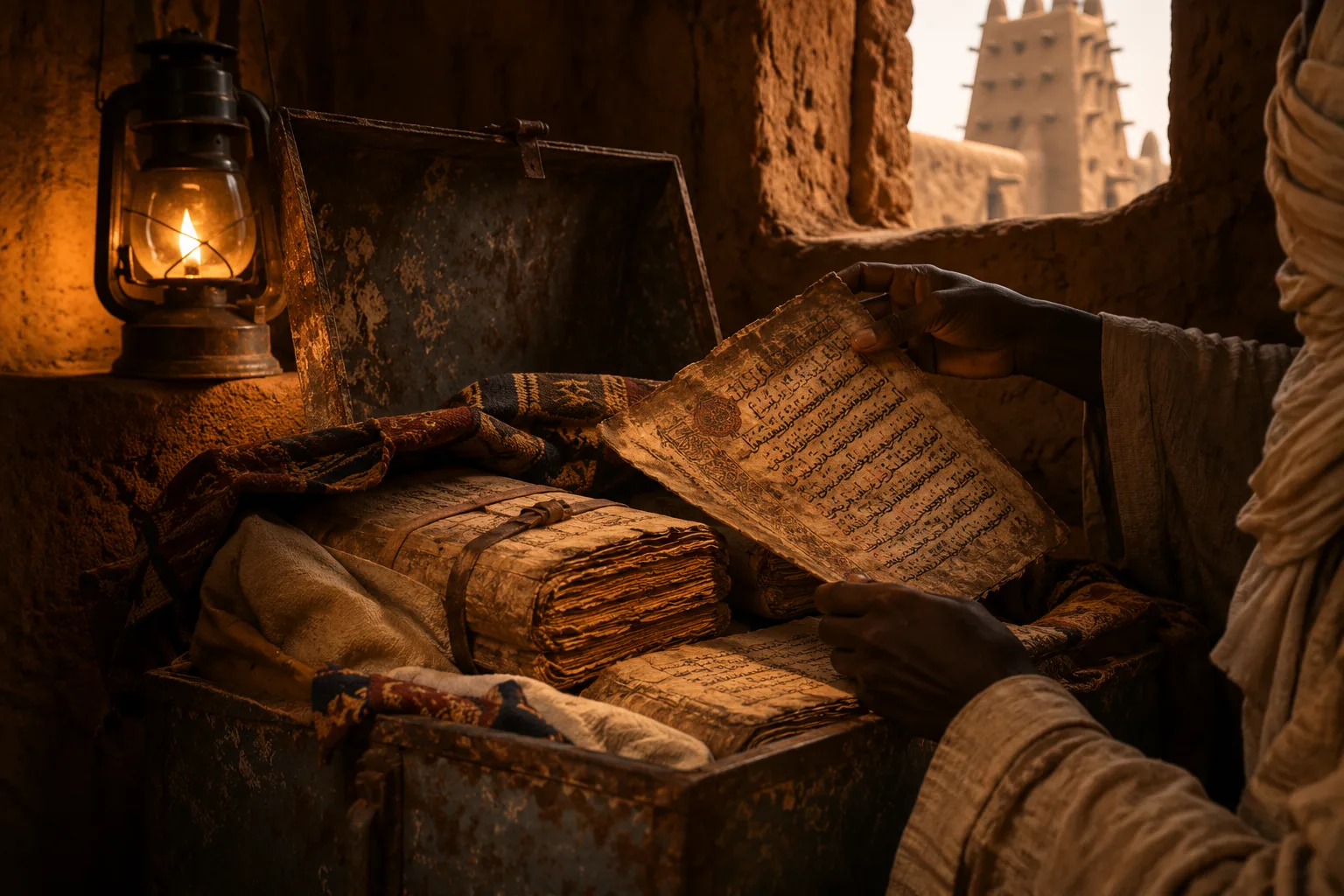
In 2012, when armed groups occupied Timbuktu, the families of the city did something no army could have ordered. Night after night, they packed manuscripts into rice sacks and metal trunks, loaded them onto carts, boats and buses, and carried them south to Bamako. Hundreds of thousands of pages, some of them centuries old, on astronomy, law, medicine and poetry, crossed checkpoints hidden among ordinary goods. Most of them survived.
Nobody paid these families to take that risk. They took it because, to them, the manuscripts were not objects. They were the proof of who they were.
The mausoleums of Timbuktu, destroyed during the same occupation, were rebuilt a few years later by the city's own masons, using techniques handed down in their families for generations. I was Mali's Minister of Culture in those years. What I remember most is not the ceremonies. It is the masons, and the quiet pride of a city rebuilding with its own hands what had been taken from it.
Culture is not what comes after
In times of crisis, culture is often treated as something for later. Security first, then the economy, and culture when calm returns. Experience teaches the opposite. When institutions weaken and markets close, it is culture that keeps a society standing: its languages, its music, its places of memory, its ways of settling disputes and welcoming strangers. It is what allows a community to recognise itself, and therefore to rebuild.
This is why the destruction of heritage is never an accident of war. Those who attack mausoleums and libraries know exactly what they are aiming at. In 2016, for the first time, the International Criminal Court tried a case centred on the destruction of cultural heritage, concerning Timbuktu, and handed down a conviction. The world had come to understand what the families of Timbuktu already knew.
In March 2017, at the Louvre, I spoke for Mali at the launch of an international alliance to protect heritage in conflict areas. The conviction in that room was simple: protecting heritage is not only a cultural policy. It is a security policy, and a development policy.
A world-class asset
Africa holds one of the richest cultural heritages on earth, and one of the least protected. Its music fills stadiums on every continent. Its cinema, fashion, literature and design are followed and imitated far beyond its borders. Its historic cities, from Timbuktu to Lalibela to Kilwa, tell a story of learning, trade and faith that the world is only beginning to rediscover.
This is a world-class asset, and it deserves to be managed as one.
- Protect it. Inventories, archives, trained conservators, and local guardians who are recognised and supported in their role.
- Invest in those who create. Musicians, artisans, filmmakers and designers need finance, protection of their rights and access to audiences, like any other industry.
- Teach it. A young African who knows the history of her own city carries a confidence that no imported curriculum can give.
Resilience begins with memory
We speak a great deal today about resilience: climate resilience, economic resilience, social resilience. All of them rest on something we rarely measure: the confidence of a people in its own story. A community that knows where it comes from bends without breaking. It rebuilds faster, because it knows what it is rebuilding.
The families of Timbuktu understood this without needing a report to tell them. When everything else was shaking, they saved what would allow them to stand again.